Turning a 40,000-word tutoring transcript into Anki cards: an OpenClaw use case
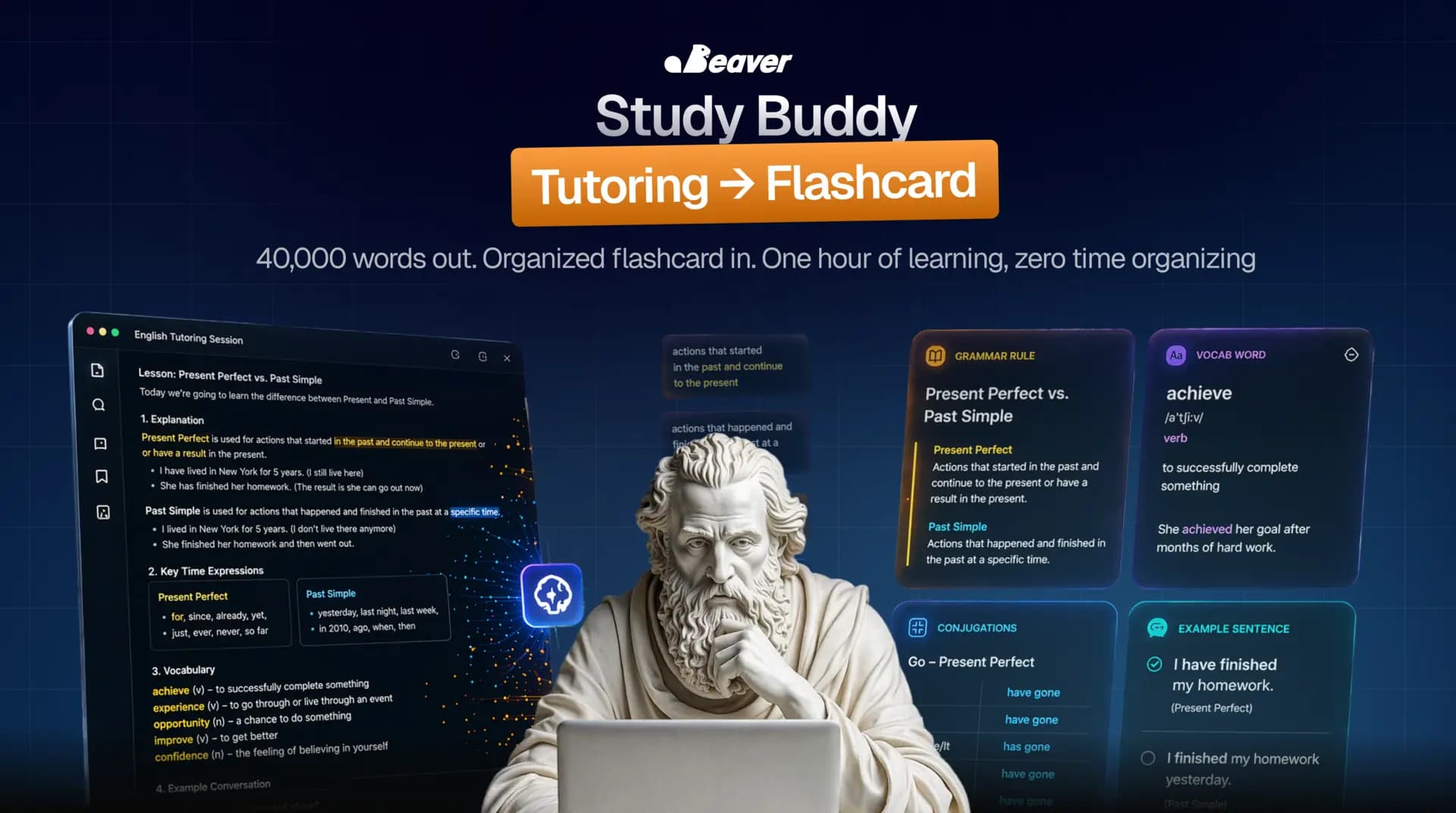
A 90-minute language tutoring session generates 300 to 600 vocabulary items, conjugations, and grammar notes. Study Buddy turns that into a deduplicated Anki deck before the headphones are off.
 Michael PansoliniApril 25, 20266 min read
Tutoring sessions produce more material than any human will sit down and re-process at home.
A solid hour of language tutoring generates somewhere between 300 and 600 vocabulary items, conjugation patterns, idiom uses, and grammar notes. The student learns most of it in the moment. Almost none of it gets reviewed afterward, because turning a session into flashcards is its own hour-long task, and the kid (or adult) who just finished tutoring has zero appetite to do that.
Study Buddy is the OpenClaw workflow that closes the loop. The transcript becomes a reviewable Anki deck before the student has put their headphones away. This post is the walkthrough: what makes the cards usable, what we learned about deduplication, and why we encode session difficulty into the deck.
What is automated flashcard generation?
Automated flashcard generation is a workflow that takes an unstructured text input (a tutoring transcript, a textbook chapter, a lecture recording) and produces a structured deck of review-ready cards. The agent extracts candidates, deduplicates by lemma and surface form, scores difficulty, generates card front and back from a card-type template, and pushes the result into a target study app.
This is a deceptively hard category. Anyone can prompt an LLM to "turn this transcript into flashcards" and get unusable output. Real implementations have to handle three things: duplicates, direction, and difficulty.
The three failure modes that make decks unusable
Most "transcript to flashcards" demos produce decks that look fine and fall apart in week one of review.
Duplicate cards. The same vocabulary word appears in two tenses across the session. A naive workflow makes two separate cards. By card 200 the student is reviewing the same word every fifth card, retention drops, and they quit the deck.
Wrong-direction cards. The student studies Spanish-to-English. The deck has half its cards as English-to-Spanish because the prompt was ambiguous. Mixed direction is worse than no card at all because it teaches the wrong recall pathway.
No difficulty signal. Every card has the same priority. The student reviews words they already know mixed with words they struggled with three times. Spaced repetition needs the difficulty signal to do its job.
OpenClaw's Study Buddy handles all three explicitly.
How Study Buddy runs
The trigger is a session transcript: from Zoom, an in-app recording, a manual paste, or a tutor's session export.
-
Ingest with speaker turns. The full transcript is loaded with tutor lines and student lines distinguishable. The agent uses speaker context to figure out who introduced a concept and who tried to use it. This becomes the difficulty signal later.
-
Extract candidates. A first pass pulls every potential flashcard candidate: new vocabulary, conjugations, fixed phrases, grammar explanations, cultural notes. Each candidate carries the transcript span it came from.
-
Deduplicate with lemma awareness. This is the make-or-break step. "Yo voy" and "ella va" are not two cards for "to go." They are one card with two example sentences. The agent runs morphological analysis before grouping, then merges duplicates while keeping every example.
-
Score difficulty from the session itself. Corrections, hesitations, and repeated misuses are audible signals in the transcript. The agent reads those, not just the words. A word the tutor introduced and the student used confidently is lower priority than one the student got corrected on three times.
-
Generate cards from a card-type template. Vocab card, conjugation card, grammar card. Front and back are filled from the template. Example sentences come from the transcript itself, not invented. This is what makes the cards feel like the student's own session, not generic textbook material.
-
Render for one target. Anki, Quizlet, or RemNote. We pick one. Trying to be format-agnostic is how cards end up looking weird everywhere.
A typical 90-minute language session generates 150 to 300 unique cards in under a minute.
What we figured out the hard way
Three things that hurt before the workflow was reliable.
Lemma deduplication is not optional. Our first version grouped on surface form. A 90-minute Spanish session produced 540 cards, of which 280 were duplicates of conjugated forms. Dedup with morphological awareness brought the count to 178 unique cards covering the same content.
Source quotes are non-negotiable. Without the source quote, cards feel canned. The student does not remember the moment the word came up, and review motivation drops within a week. Every card now carries the exact transcript line, including the surrounding context, in the back of the card.
Difficulty has to be visible in the front-end. Anki ranks by review history. We started exposing initial difficulty as a tag (introduced, struggled, corrected) so the student can filter by what they actually need to review first. Without that tag, every card starts equal and the struggle ones get buried.
When Study Buddy is the right tool
This workflow earns its setup when:
- You (or your kid) have a regular tutor and the post-session review never actually happens
- The subject is fact-dense: languages, biology, law, medical, music theory
- You already use a flashcard tool: Anki, Quizlet, RemNote
It is the wrong call for purely conceptual subjects (philosophy, literary analysis) where flashcards are the wrong format anyway. We have seen people try to use it for graduate seminars, and the deck quality drops because the underlying content is not card-shaped.
The numbers
For a serious language learner doing two sessions a week:
- 30 to 60 minutes of post-session card creation per tutoring hour, eliminated
- The retention drop from skipping review entirely (which is what most students actually do)
- Deduplication that takes a 540-card raw extraction down to roughly 180 unique cards
The compounding win is review consistency. When the deck is waiting, the student opens it. When the deck has to be built first, they do not.
FAQ
Does this work for non-language subjects? Yes, with a different card-type template. We have run it on biology lectures, contract law tutoring, and music theory sessions. The dedup logic is language-aware but the workflow is general.
Can it handle multiple languages in one session? Yes. The agent identifies language per utterance and routes vocabulary into the correct language deck.
How does it handle tutor-introduced grammar rules versus vocab? Grammar gets a different card type with the rule statement on the front and an example pair on the back. The card-type assignment happens during extraction, not after.
What if the transcript has audio errors? Low-confidence transcript spans are flagged, and cards built from them go into a separate "review before adding" pile. The main deck only contains cards built from high-confidence spans.
Wire it up to your tutor's flow
If you want Study Buddy running against your tutor's session recordings or LMS, browse more community use cases or book a white-glove install.